Showing posts with label film photography. Show all posts

Thursday, September 7, 2023

 Recently I started scanning old negatives, with an emphasis on selecting the very best images. Starting semi-randomly with 2007, of very roughly 4,000 negatives about 20 were scanned, and a few off those will drop out. Last night I went back to the beginning, looking through the really early stuff. I expect this will be mostly a winter project, something to do on rainy days and long nights. The system is in place now to facilitate that.

There's really nothing at that level to scan from the very earliest years. As a photojournalist it was a job, not fine art. Later I learned they aren't incompatible, but my early learning came mostly from the prior generation. Most of those guys were ex military photographers, ex photojournalists, guys from the Speed Graphic era of contrasty images and predictable subject matter. I was, literally, taught to put the emphasis on efficiency, to treat subjects as just one more assignment and not think too much beyond the essential technical stuff. Considering I was 15 when I sold my first photo, at first I didn't question that a whole lot. It was later, in my early 20s, that the rebellion came.

The first image that really stands out was taken in the summer of 1998. It was for a model composite, part of a series of shoots. I think the stage mom was in part trying to. set me up with her daughter, but there wasn't much interest on my part. Nice kid, pretty girl, not very interesting intellectually. She was a gymnast and dancer, relatively good muscle tone which meant, in 1978, she was a little ahead of her time. I was interested in that muscle tone, it was something different then and it lit beautifully, but she never made it past local sporting goods work as a model. Anyway there were a lot of technically competent images but with not a lot of spark to them. She wasn't real expressive and I hadn't learned to draw it out yet. The one really nice photo happened half by accident. I guess the location contributed and her pose had a dancer's grace, and she had a soft smile that appears to be natural. I think the framing between small trees on the left and right was an intentional part of the composition, what I didn't see til later was that the shrubs in the background, 20 feet behind her, when foreshortened with a short telephoto completed a darker circle. The model was centered in the lighter opening, and her extended fingertips just touched the darker edge of the outer circle which framed the border. At least I recognized right away on the negative that we had something special, and I made a bunch of prints of that one including some archival and selenium toned portfolio prints. The image also was one of three used on the composite.

So for those first years... from early 1971 through early 1981... just that one image stands out from all the rest, from probably a couple hundred thousand negatives run through multiple cameras on paid assignments plus a much smaller amount of personal work. That all changed in 1981.

What was new was that suddenly it wasn't just a job. When I took my first photos of the Chicago punk scene in December 1980, there was a new excitement, a new passion that hadn't been there before. It wasn't til early March that I did more photos, including my first band photos (Bauhaus and Da were on that couple of rolls from early March. A few photos from that show have been published and exhibited several times, and I selected two of them as standouts. Then in April, portraits of new friends in the alternative music scene. Three of them were special, two who became close friends and one I barely knew, and who died unexpectedly just months later. 

I've gotten only a little past that so far, there are a couple of July images selected to scan soon, and there will be several more in the balance of 1981 and 1982. Then it's going to skip some years, because after spring 1983 I burned out on the extreme intensity of the post-punk scene and mostly put the camera aside until the late 1990s. After that I was on a different path but one first inspired by those 1981-82 images, one that was much easier because of things first learned then. Part of the rejection of the materialistic values of the older generation of photographers (not all of them, because of course some of the earlier street and art photographers later became influences, but I hadn't found them yet) was very conscious and intentional... listen to the lyrics of the Joe Jackson song "Look Sharp" sometime, it resonated with some of us... although it went even deeper than I understood at the time.

Tuesday, August 1, 2023

New From Old


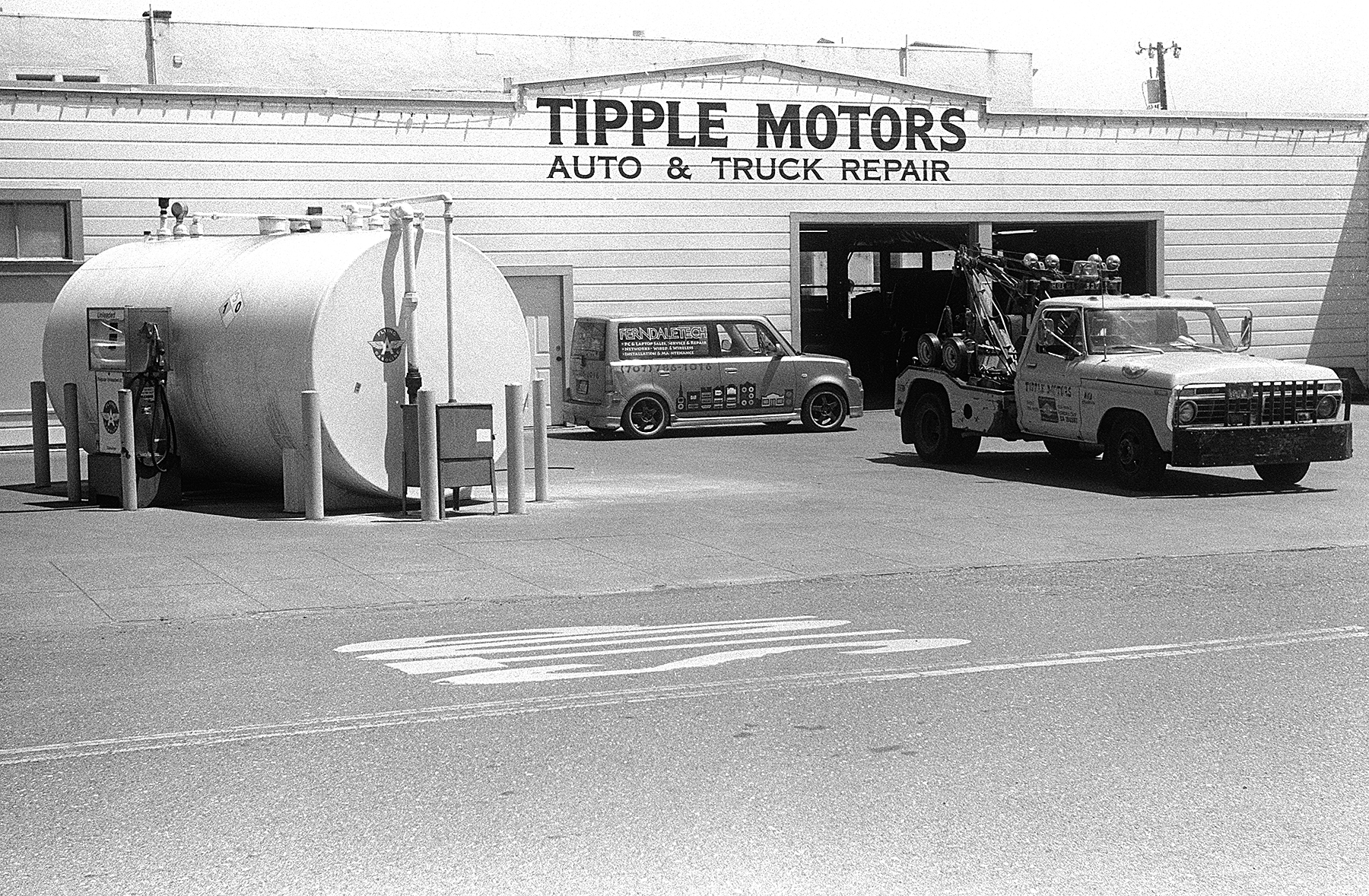
From the test roll run through the IIIb and 50 Elmar over the weekend. OK for an 85 year old camera body and a perhaps 75 year old lens. The sharpness actually surprised me a little. Avoid potential flare situations, and the old glass can hold its own. HP5 at EI 200, HC-110 dil H, full afternoon sun. 

Everything seems to work, so done with the IIIb for a while. Next step is to test some fairly economical film for general use in more modern gear, everything needed arrived today.

Monday, July 31, 2023

Leica M6TTL


 That's my well used M6TTL in the photo. Purchased new in 1999, it's created some of my best images over the years. It's usually paired with a 50mm Summilux as shown, a 1980s vintage pre-aspherical which has been very effective for wide open or low light photography; the 0.85x finder on this camera body has been a big help with that and makes focus easy.

This camera has had a lot of frames through it. There's some wear, which shows as silver on the zinc top plate. It has a little of the "bubbling" characteristic of the zinc top plate, and perhaps encouraged by the mild, humid winter rainy season conditions here on the coast and occasional fine salt spray from all those shoots at the dunes. It's not that noticeable and if anything is a good reminder that this is a camera to use, not to look pretty on a shelf. 

One of my few dislikes about the M4-2/M4-P/M6 series of bodies is the prominent white "Leica" on the front, I prefer to be a bit less obvious than that. So when the white began to scuff and flake off some years back, I used a toothpick to get the rest of it out of there. It's now much less obvious than the strongly lit photo would suggest, it's quite hard to see except up very close.

Using this body more often in recent weeks has reminded me that if necessary I could get by with just this one body and lens. The 50mm is my favorite on an M body and in the past I've gone possibly as long as two years at a time with this same lens mounted.

Anyway, I have four rolls of HP5+ ready to process, three of them from this camera and one a test in the IIIb. There's a bottle of HC-110 (what I prefer to use with HP5) on a FedEx truck on the way, supposedly to be delivered today, and also a few more rolls of film in that box.

Saturday, April 16, 2022

Film

 Because it's been a while since I've processed film in quantity, I'm stepping back and making fresh decisions about which products to work with. That's because things change over time; the film stock, the chemistry, the nuances of my processing technique, my preferences for the end look. There's a great deal of misinformation on the internet, much of it from well-meaning newcomers who either read it somewhere else, or are doing their best to interpret their own results but not controlling for variables. For example, I've seen at least two recent statements that Tri X allegedly hadn't changed at all since introduction; one claimed to quote a post by a guy from Kodak (but with no link or citation). It's not even close to true, one look at my early work and more recent work makes that very obvious. Other sources claim multiple changes over time which is far more likely to be true. There was one big change that resulted in Kodak publishing new processing times (according to Wikipedia, this change was in 2007 and included allegedly finer grain and less silver; but they don't cite a source either. I do know that some of the new HC-110 times are not accurate, see the notes on Massive Dev Chart and my own experience backs that up).

So at the moment I have four rolls of Tri X, and two rolls of FP4 ready to proof and there are a couple of rolls of HP5 ready to process. All were done in Rodinal at 1:50 dilution and all with the same agitation and temperatures. I'll print a few examples, see what I like and don't like, and then shoot some more with whatever seems to be working for me. There are a few old rolls of 120 sitting around too, one-offs of each of several film types, great reason to run a couple more rolls through a medium format camera.

I probably won't settle on just one thing. Rodinal is a high acutance developer, which I like; that means the edges of the grain are less diffused, which gives the appearance of more grain and better sharpness although it's not really the same thing. That works for some subjects, not as much for others. So for those other things, I could use FP4, or I could just go to medium format... which I may very well try for the landscape work. It's a heavier rig but can be set up to be not too bulky. A tripod is a big advantage with larger cameras. I may not want to haul that on a 12-mile backcountry hike over rugged terrain, but close to the road it's perhaps worthwhile. 

I'll zero in pretty quickly on what I want to use. Things other than the look of the images may or may not factor in. 35mm Tri X is about $2.37 per roll more expensive than HP5. That doesn't matter for a few rolls, but over a hundred rolls it adds up. But then Tri X is available in 100 foot rolls for a better price, and I still have two of my old bulk loaders and would just need to buy a few new reloadable film cassettes at $2-something each and see if I can find the trimmer for the roll leader. So HP5 has a cost edge for small to medium quantities, but not for large quantities. Then there's the matter of whether one company is more deserving of support than another. I'm just beginning to look at that. Kodak is presumably still a fairly typical large publicly held corporation. At last check Harman (Ilford) was owned by a venture capitol firm. Either way, they're about making a profit and may or may not differ in how much they actually care about photography. That will take time to research and it's not a top priority this week. It's something I'll want to forget the moment I pick up a camera and go in search of images. There, it would just get in the way.

One thing that has become painfully clear doing just this little bit of information gathering: A lot of once commonplace film photography knowledge is rapidly being lost. Things that were once on my darkroom shelf, and that of most every other serious photographer, have in some cases become hard to find and often hidden behind internet misinformation. Young photographers, if you have opportunities to learn from older folks who learned when there was only film, go for it while you still can. Gramps may know things he's forgotten he knows, and will probably benefit from being around your creative energy. Maybe he'll even dust off that old camera.